GPUs, FPGAs and many cores
Learning hardware is useful when its capabilities match the structure of a computation. Numerical operations may be repeated over arrays, while data preparation can involve irregular access and decisions. A system must also move observations and parameters into the memory where those operations run. Counting arithmetic capacity alone leaves out much of the work.
Multicore processors, graphics processors and field-programmable gate arrays offer different arrangements for parallel execution. Software abstractions connect those arrangements to mathematical expressions. Theano provides a research example of that connection, while convolutional networks and image datasets help explain the workloads that made it important.
Many cores within a machine
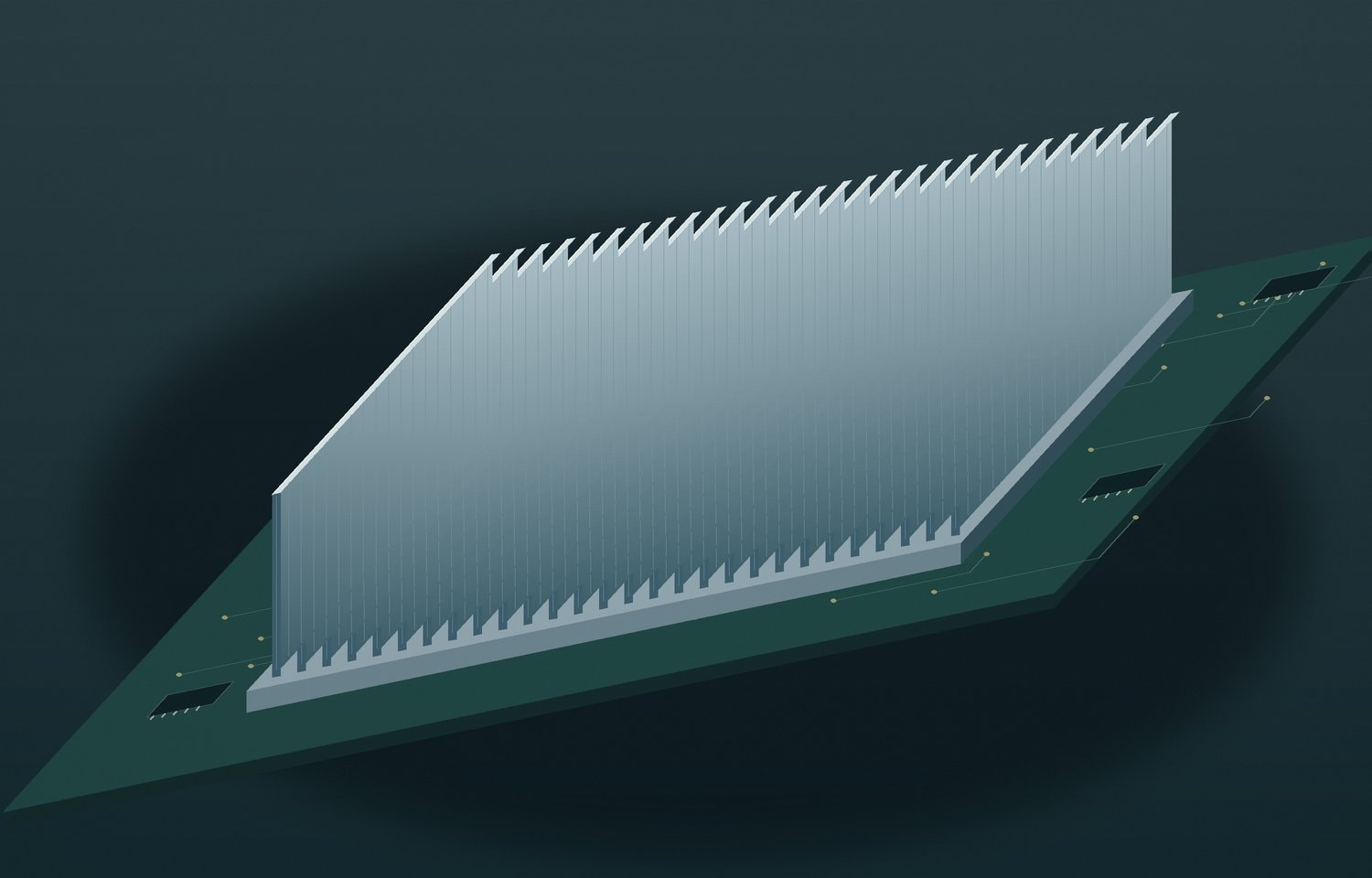
A multicore processor contains separate processing cores within a physical package. Each core executes instructions, and a program designed for parallel work can use several cores concurrently. The cores may share some memory and cache resources. This arrangement provides a common machine boundary, but it still requires a method for dividing work and managing interactions between concurrent operations.
Shared memory makes communication different from sending messages across a cluster. It does not eliminate contention. Several workers can compete for access to memory or attempt to change related model state. The stochastic-optimisation topic discusses why the pattern of parameter updates matters when parallel execution is introduced. Hardware and the update rule need to be understood together.
Graphics processors beyond graphics
Wikipedia’s article on general-purpose GPU computing describes using graphics processing units for applications traditionally handled by central processors. Many numerical learning operations apply similar calculations across substantial arrays. This exposes parallel work that can be arranged for a graphics processor, provided the data and operation fit its execution model.
Data movement remains part of the calculation. A processor cannot use values that have not reached the memory available to it. Transferring inputs and results between a CPU and a GPU therefore belongs in the cost of an operation. Reusing data near the computation can change that balance, while repeated small transfers can make a nominally parallel calculation expensive to organise.
Configurable circuits
A field-programmable gate array, or FPGA, contains configurable logic blocks and connections that can be programmed after manufacture. Instead of expressing all work as an instruction sequence on a conventional processor, a configuration defines digital functions in the device’s logic. This supplies another route to parallel computation, including arrangements in which data pass through a sequence of operations.
The flexibility comes with a different programming task. A hardware description must account for the organisation of operations and connections. The suitability of a learning workload depends on its numerical operations, data access and the frequency with which the computation changes. The existence of parallel work alone does not decide whether it belongs on multicore processors, GPUs or configurable logic.
Theano connects expressions and execution
The research paper Theano: A Python framework for fast computation of mathematical expressions described a library for defining, optimising and evaluating expressions involving multidimensional arrays. Theano expressed mathematical operations in Python and used an optimising compiler to execute them on CPU or GPU architectures. This separated the statement of an array computation from many details of the chosen execution path.
That separation matters because a mathematical expression can expose relationships between operations. Intermediate values may be reused, operations may be arranged differently and an execution plan must determine where values live. Compilation adds a layer between the learning model and the physical hardware. Understanding that layer helps explain why two ways of expressing similar mathematics can place different demands on memory and scheduling.
Convolutional networks and image data
A convolutional neural network learns filters that operate across input regions with shared weights. This structure gives many locations a related numerical calculation while retaining a limited set of filter parameters. Training still includes the work of applying the model and updating its parameters. The structure of the network determines what can be reused and which operations must follow others.
Wikipedia’s ImageNet article describes a visual database designed for object-recognition research, with annotated images and object categories. Such data provide a concrete setting in which model computation, input preparation and evaluation meet. The scale of a dataset and the computational demands of a network are separate characteristics; either can become a constraint on a training process.
Neural-network foundations and the systems question
NobelPrize.org’s account of the 2024 physics prize described work by John J. Hopfield and Geoffrey Hinton that helped lay foundations for machine learning with neural networks. Its explanation connected network methods to concepts from physics. These foundations concern how connected computational structures can store patterns and learn properties of data, rather than a particular accelerator device.
The distinction places hardware in context. A neural-network method supplies the computation to be performed; the system must arrange that computation within limits of memory, communication and energy. The parameter-server topic follows those issues across machines. Within a machine, the same practical reasoning asks where data reside, how much parallel work exists and what coordination the mathematical procedure requires.