Graph-parallel computation
Some learning problems are organised around relationships. A computation at one location depends on neighbouring values, and a change can affect what another location should do next. A graph makes that dependency structure explicit: vertices hold entities or state, and edges describe connections between them.
Graph-parallel computation uses that structure to organise work. It asks which local operations can proceed together, how shared data remain consistent and how the graph should be divided between machines. GraphLab, Distributed GraphLab and PowerGraph explored these questions through research abstractions designed for graph-structured computation.
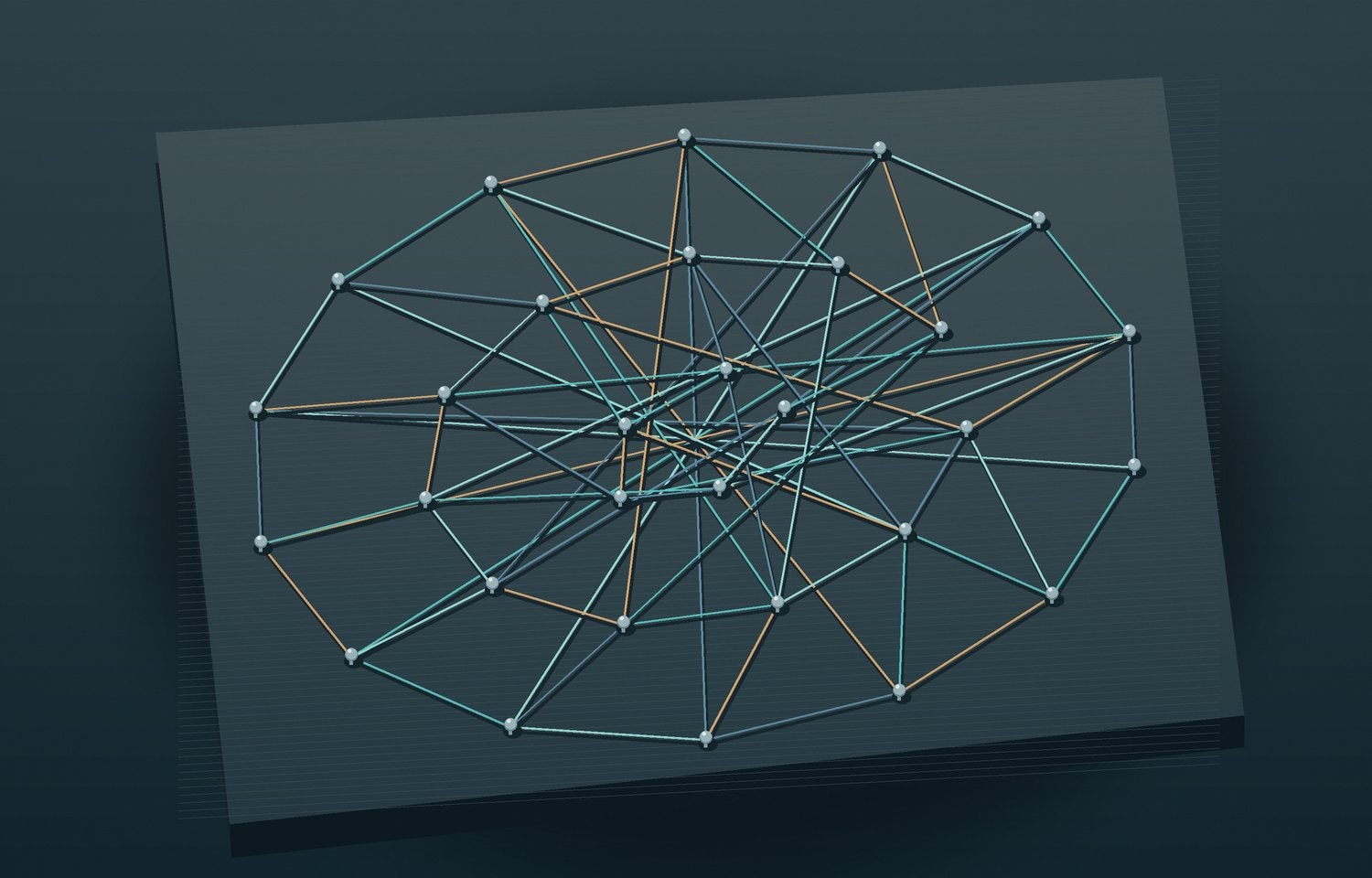
Local updates with connected dependencies
The research paper GraphLab: A New Framework for Parallel Machine Learning described an abstraction for asynchronous iterative algorithms with sparse computational dependencies. Its reported examples included belief propagation, Gibbs sampling and other learning procedures. The central idea was to expose recurring dependency patterns rather than require each application to solve low-level coordination problems independently.
A graph expresses which pieces of state are connected. Sparse dependencies mean a local calculation needs only part of the full system’s information. This can reveal opportunities for parallel work, but it also exposes overlap: neighbouring updates may read or change related state. The abstraction must therefore define the permissible interaction between updates, rather than simply dispatching every available operation at once.
Asynchronous execution allows operations to proceed without requiring a global meeting point after every local update. It can follow an irregular pattern of work through the graph. The mathematical procedure and the scheduling procedure still need compatible assumptions. If an update relies on a particular relationship between old and new values, consistency rules must make that relationship clear.
From shared memory to a network
Distributed GraphLab: A Framework for Machine Learning in the Cloud extended the GraphLab framework to distributed execution while maintaining strong data-consistency guarantees. The paper described graph-based extensions to locking and data versioning to address network congestion and latency, and added fault tolerance. Its subject was the extra machinery required when dependent operations cross machine boundaries.
In shared memory, processors can access a common address space. In a distributed setting, information held on one worker must be communicated before another worker can use it. An edge connecting different partitions can therefore represent both a model dependency and a communication requirement. The placement of graph data changes the physical cost of satisfying those dependencies, even when the learning objective remains the same.
Partitioning work without ignoring relationships
Graph partitioning groups vertices into parts. For distributed computation, a useful arrangement must consider both the amount of work in each part and the edges crossing between parts. Keeping connected data together can reduce communication, but concentrating too much work in one place leaves other resources waiting. The appropriate balance depends on the graph and the operations applied to it.
The USENIX paper PowerGraph: Distributed Graph-Parallel Computation on Natural Graphs highlighted highly skewed degree distributions in natural graphs. A vertex with many connections creates a different workload from one with only a few. Dividing vertices equally therefore does not necessarily divide processing or communication equally. The paper introduced a graph abstraction and a placement approach that addressed these structural challenges.
That observation is broader than the name of a system. The logical unit being counted must match the work that matters. A partition with few vertices may still contain many relationships; an operation may spend time traversing those relationships rather than visiting vertices alone. Systems analysis therefore follows the actual dependency and access pattern rather than relying on the size of a partition’s vertex list.
Bulk-synchronous steps
Wikipedia’s bulk-synchronous parallel article describes computation arranged in global supersteps, including communication and a barrier. At the barrier, a process waits until the other processes reach the same point. This supplies a clear separation between rounds of work and makes synchronization part of the computational model.
A round-based arrangement and an asynchronous arrangement expose different reasoning tasks. Global rounds make the boundary between stages explicit; asynchronous operations require attention to which information each operation has seen. Both must account for communication and uneven workloads. A barrier can make a delayed worker visible to the rest of the job, while overlapping operations still need rules for interacting with shared state.
A graph database serves a different purpose
A graph database stores entities and relationships so that queries can traverse connected data. Graph-parallel computation describes how operations run over graph-structured state. The two concepts can meet in a data-processing workflow, but naming a graph representation does not establish the execution model. Storage organisation, query semantics and learning updates each have their own requirements.
The database topic considers the relationship between managed data and analytics, while dataflow systems represents dependencies between processing operations. Graph-parallel learning instead gives special attention to dependencies within connected model state. Across these approaches, the practical question remains how to organise useful work while defining communication, consistency and restart behaviour precisely.